

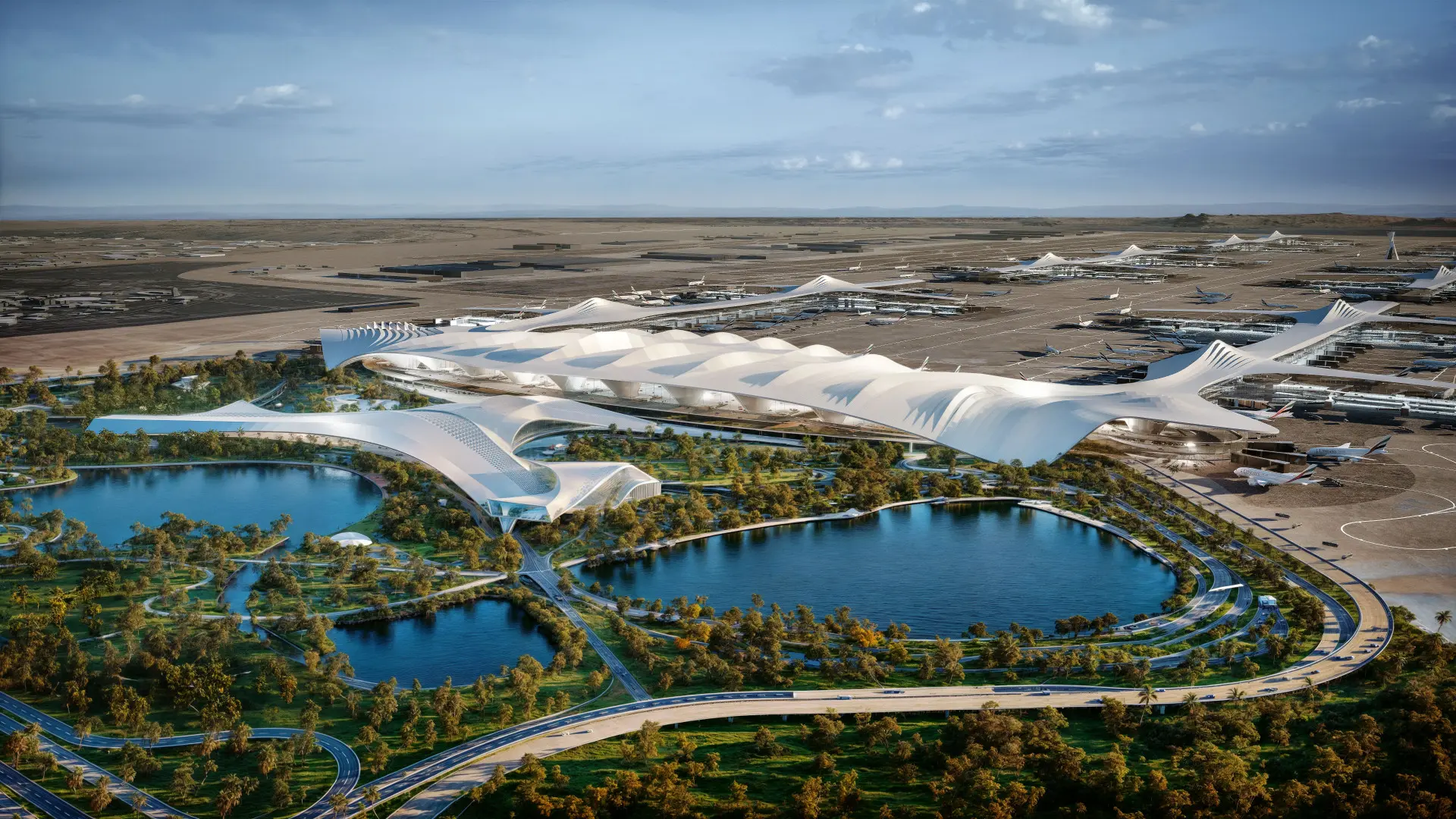
In April 2024, Sheikh Mohammed bin Rashid Al Maktoum, the Ruler of Dubai, approved the final designs for the massive AED128 billion expansion of the Al Maktoum International Airport. Set within the vast masterplan of Dubai South, the emirate is building what could become the Middle East’s largest, most ambitious airport city, or, as some call it, an aerotropolis.
The idea of an airport city is simple but transformative. Across the world, major airport expansions are no longer just about moving people from one runway to another, they are about building new urban centers that anchor trade, tourism, investment and communities.
Global examples show the power of this model. Heathrow has transformed West London. Singapore’s Changi has created a hub of logistics and leisure. Istanbul’s new airport is reshaping northern Istanbul. But will Dubai’s airport expansion spark a similar wave of growth?
Experts believe that Dubai’s bold ambitions for the airport expansion could set a new international benchmark, but the true test lies in whether growth is sustainable.

Kirill Dolgin, Founder and CEO of Dubai based proptech company, BrokerDeck says, “Global examples like Heathrow and Istanbul teach us that speculative spikes are temporary. Lasting value is built on genuine economic activity – retail, hospitality, and corporate relocation, not just hype. Istanbul’s new airport, for instance, took several years to fully impact property values. Dubai’s advantage lies in its government-led master planning and the integration of Expo City, providing a much stronger foundation for sustainable growth”.
Ripple effect on Dubai real estate market
While economic activity is expected to boom in Dubai South, that’s not where it will stop. The expansion is set to have a ripple effect across the entire Dubai real estate market.
Amr Kandeel, Head of Strategy at the homegrown property developers, One Development says, “From my experience, whenever Dubai delivered big infrastructures like Downtown, Marina, or the Metro, land values jumped 25–40 percent in the early years. I see a similar uplift here, with areas that are considered peripheral today becoming central in the next decade”’
Dolgin agrees, “Historically, Dubai’s megaprojects have increased property values within a 20-30 km radius. We anticipate a familiar pattern: an initial rush from speculators, followed by sustained, long-term price growth as airlines, logistics firms, and hospitality groups expand their footprint”.
He further states that the Dubai South is ‘ground zero’ for the transformation and that significant growth can be expected in residential and commercial real estate across Jebel Ali, Dubai Investment Park (DIP), and Expo City. The improved connectivity will also boost demand in established communities like Jumeirah Golf Estates, Motor City, and Arabian Ranches, as professionals seek homes nearby.
Transport connectivity
Transport connectivity will be a major factor contributing to the success of the aerotropolis’ real estate ecosystem. Kandeel believes it will be the make-or-break factor. “In every global case, connectivity defined success. Metro links, highways, and logistics corridors raise land values and make areas livable. For Al Maktoum, the metro extension, highway upgrades, and Etihad Rail are vital. If travel time to Downtown is kept under 25 minutes, the airport zone will no longer be seen as ‘far’ – it will stand as a prime new hub for both living and business,” he says.
Among the most significant factors shaping the success of the mega expansion will be interest from key demand drivers. Kandeel highlights that affordable housing will serve tens of thousands of aviation and service workers who need to live near their jobs and high-end mixed-use projects will attract investors, corporates, and global residents who want a premium lifestyle close to a major hub.
“The winning formula is balance. Affordable brings volume and community, while premium drives branding and value,” he says.
Dolgin adds that global capital is already paying attention, noting that the expanded airport cements Dubai’s position as a world-class aviation hub, rivaling Istanbul and Doha. For international investors, Dubai’s clear regulatory framework and the project’s government backing provide certainty. Furthermore, the entry prices in Dubai South offer a compelling value proposition and greater potential for yield compared to prime areas like Downtown or the Marina.
He highlights the investment horizon, adding, “We see a two-phase trajectory. From now until 2028, expect modest appreciation (10-20 percent) driven by speculation as the infrastructure takes shape. The real, steady growth will occur from 2028 to 2035, once airlines have shifted operations and the area’s population has grown. This opportunity best suits investors with a 7-to-10-year horizon; short-term flippers may miss the mark”.
Dubai South – The new axis of growth
As Al Maktoum International Airport takes shape, investors are already turning their gaze southwards. The AED128 billion expansion aligns closely with Dubai’s Economic Agenda D33 which aims to double the size of the emirate’s economy by 2033 and boost its position as one of the world’s top three cities for business and tourism.
Key drivers include:
Freehold Accessibility: Dubai South, unlike many airport zones globally, offers freehold property ownership for foreign investors, with leading developers such as Emaar, Mag, and Damac launching residential and commercial projects in the area.
Infrastructure Synergy: The airport’s direct links to Etihad Rail, Dubai Metro extension, and Jebel Ali Port are creating the GCC’s first fully integrated air–sea–land logistics hub.
Regulatory Clarity: Backed by Dubai Land Department’s transparency index and the emirate’s streamlined registration system, long-horizon investors gain greater certainty and protection.
Returns Outlook: Current yields in Dubai South average 7–8 percent with analysts predicting gradual appreciation of 10–20 percent by 2028, followed by stronger gains post-2030 as airlines and logistics firms scale operations.
A city within a city
The Al Maktoum expansion isn’t just building an airport, it is building a community. The wider Dubai South masterplan envisions a fully integrated urban ecosystem where residents can live, work, and play within 15 minutes of key amenities.
Planned Neighbourhoods: Projects like Emaar South and The Pulse are introducing family-friendly communities with schools, clinics, retail plazas, and parks designed around walkability and green mobility.
Workforce Housing: Affordable developments are planned for thousands of aviation, logistics, and service workers, ensuring inclusive growth alongside premium real estate.
Smart Infrastructure: Solar-powered street lighting, digital traffic systems, and high-speed fibre connectivity are being embedded from the start, setting new sustainability benchmarks.
Early Ripple Effects: Café owners and local businesses in Expo City and DIP report increased traffic and leasing inquiries since the project’s announcement.