



Dubai has emerged as the costliest city to rent in the Middle East, ranking eighth globally with an average monthly rent of $2,401 (AED8,817) for a one-bedroom apartment.
According to new data published by Visual Capitalist last week, based on Deutsche Bank figures, rental costs in Dubai have soared 54 percent, cementing its position as one of the priciest rental markets worldwide.
This increase has pushed Dubai ahead of other Middle Eastern markets, where no other city made it to the global top 10. A separate Haus & Haus report shows that Downtown Dubai is the most expensive neighbourhood to rent, with rates at AED117 per square foot—31 percent above the emirate’s median. On Bayut.com, one-bedroom apartments average AED97,727 annually, while Property Finder data suggests that nearly 80 percent of renters in Dubai prefer apartments over villas.
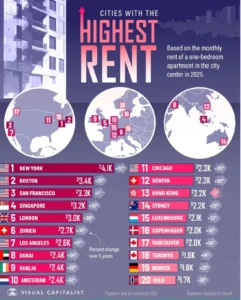
Globally, New York tops the list with an average monthly rent of $4,143 (AED 15,215), followed by Boston at $3,394 (AED12,464) and San Francisco at $3,332 (AED12,236). Singapore leads Asia with $3,167 (AED11,630), reflecting a 55 percent surge in rents over the past five years. European hotspots London at $2,985 (AED10,962) and Zurich at $2,720 (AED9,989) also dominate the rankings. Dubai sits just behind Los Angeles ($2,613/AED9,596) and Zurich, but ahead of Dublin ($2,378/AED8,733) and Amsterdam ($2,358/AED8,659).
Why are rents rising?
Analysts say inflationary pressures, rising construction costs, and limited housing supply are driving up rents worldwide. In Dubai, high demand from new residents, coupled with limited prime stock, has added fuel to the surge. “Record-high housing prices, paired with a wave of remote workers moving into new markets, are reshaping rental dynamics,” the report noted.
Globally, the rental housing market is projected to hit $2.56 trillion by 2032, driven by urbanisation and a growing preference for the flexibility of renting over ownership. While countries like Switzerland and Germany remain rental societies, others such as China and Russia continue to favour ownership, with more than 80 percent of adults living in owned homes.